
Maths
Maths is an essential skill that enables us to live an independent life. It teaches us how to make sense of the world around us, whether it be calculating the total amount of money we need to purchase items, knowing what time to board a train or weighing precise amounts of ingredients when following a recipe. Maths helps us to develop problem solving and reasoning skills that allow us to solve a variety of problems.

Intent:
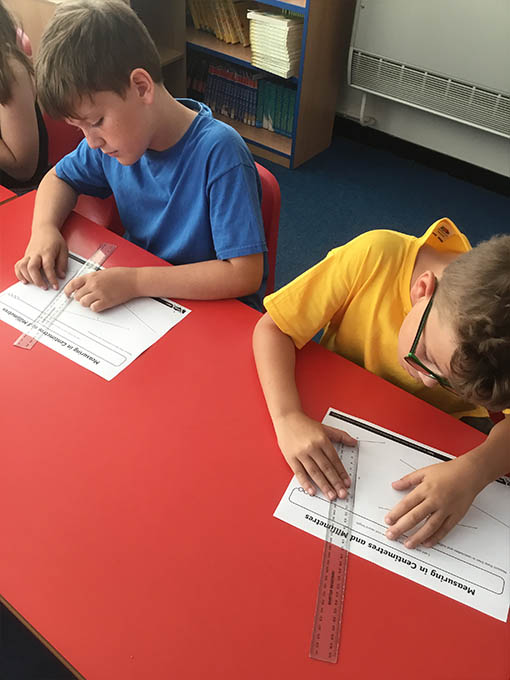
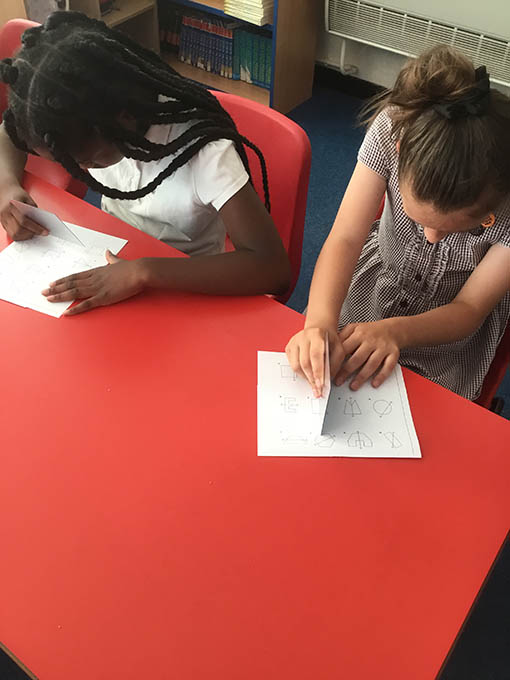
- Pupils ‘see’ the role of mathematics in their daily lives as there are frequent opportunities for pupils to apply Maths to a ‘real-life’ situation.
- Skills are taught sequentially to build confidence and the ability to manipulate numbers.
- The National Curriculum objectives are met in a range of ways.
- Pupils are equipped with skills for life which will enable them to function in society e.g. the ability to tell the time, use money etc.
Implementation:
- Subject leader is well versed in the expectations of all pupils and offers support when and where needed.
- Staff receive training to implement the curriculum so that there is a consistent approach from EYFS to Year 6.
- Systems of assessment are embedded and inform planning and next steps.
- Tasks are adapted so that all pupils experience a sense of achievement.
- Cross curricular links are made where possible.
- Opportunities for greater depth learning are apparent.
Impact:
- Pupils demonstrate a quick recall of facts and procedures. This includes the recollection of times tables.
- Pupils show confidence in believing that they will achieve.
- Each pupil achieves objectives (expected standard) for their year group.
- Pupils have the opportunity to develop the ability to recognise relationships and make connections in maths lessons.
- Mathematical concepts or skills are mastered when a child can show it in multiple ways, using the mathematical language to explain their ideas, and can independently apply the concept to new problems in unfamiliar situations.
- Children show a high level of pride in the presentation and understanding of their work.
Vision:
Mathematics at Abbey Primary School aims to give children the best start to their experiences of Maths by making it an enjoyable subject that prepares them for Mathematics in everyday life. Everything that is taught builds the solid foundations for Maths delivered later in the curriculum in Primary school and beyond.
At Abbey Primary School, our vision for Maths is that all pupils will:
- be fluent, reliable calculators
- display genuine, deep understanding by exploring concepts using concrete and pictorial approaches
- articulate and represent reasoning using the language of mathematics
- be skilled problems solvers, applying a range of logical and systematic strategies
- be adept at distinguishing between using the relevant mental and written procedures
- show rapid recall of number facts rooted in secure understanding
- make links and connections across mathematical domains and apply skills throughout the wider curriculum
- show a developing resilience, perseverance and independent thought
Teaching and learning style:
At Abbey Primary School, we uses a variety of teaching and learning styles in mathematics lessons. Our principal aim is to develop children’s knowledge, skills and understanding in mathematics.
We do this through a daily mathematics lesson where children are given opportunities for:
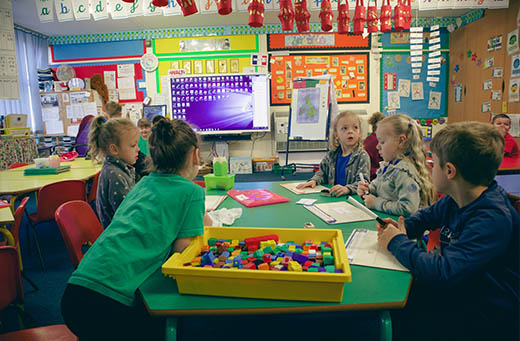
- Practical activities and mathematical games
- Problem solving
- Open and closed tasks
- Individual, group and whole class discussions and activities
- A range of methods of calculating e.g. mental, pencil and paper and using a calculator
- Working with computers as a mathematical tool
- Using a wide range of support resources e.g. number squares, digit cards and number lines
- Using and applying their learning in everyday situations
- We teach maths units provided by White Rose Maths and source other resources that are suitable to meet the objectives of the National Curriculum.. We ensure that children have opportunities to develop their fluency, reasoning and problem solving and emphasise the importance of using concrete resources to help children to fully understand concepts.
For further information about White Rose Maths please click on the following links:
https://whiterosemaths.com/for-parents/advice-and-guidance/
https://whiterosemaths.com/maths-with-michael#watch
We use a range of software to support the teaching of Maths.
These include NumBots, TT Rock Stars and Freckle. These websites can be accessed at home to further support your child in their learning. Your child has individual logins for these accounts.



Helping your child with Maths at home:
Please find links to useful websites:
ictgames
EYFS
Help your child be epic at maths – CBeebies – BBC
KS1
KS1 Maths – England – BBC Bitesize
Parent information for the Year 4 multiplication tables check:
Year 4 Multiplication tables check
Helping your Year 6 child prepare for SATs:
5-a-day – Corbettmaths Primary
Calculation Policies:
Our Calculation Policy follows White Rose Maths and illustrates how we teach children the four operations (addition, subtraction, multiplication and division) using the CPA approach below.
Concrete — using manipulatives (e.g. dienes and place value counters)
Pictorial — drawing their own representations of the concrete
Abstract — calculations using numerals and symbols
WRM and Abbey Primary School Addition and subtraction calculation policy
WRM and Abbey Primary School Multiplication and Division calculation policy